
Bringing a 30kVA Generator Back to Life.
A lumber yard in a remote, fully off-grid part of East Sussex had one source of power: an old 30kVA Perkins generator. It arrived non-operational — and with no grid connection to fall back on, that meant no power at all. We got it running, serviced it properly, modernised the controls for remote start and monitoring, and rebuilt the distribution around it.
- Generator
- 30kVA Perkins
- Site
- Fully Off-Grid
- Role
- Sole Source Power
- Sector
- Lumber Yard
The Problem: A Site With No Power At All
A lumber yard in a remote, fully off-grid corner of East Sussex had a single source of power — an old 30kVA Perkins generator. It didn't run.
On a site with a grid connection, a dead generator is a problem you schedule. Here there was no connection to fall back on. The generator wasn't the backup; it was the supply. With it out of action the yard had nothing — no machinery, no lighting, no welfare facilities, no business.
That is the defining constraint of off-grid work, and it changes what a good outcome looks like. Getting the engine to turn over is not the job. The job is leaving the site with power it can actually depend on, plus some way of knowing the state of it without standing next to it.
Step One: Get It Running, Then Get It Right
We got the Perkins running again. That alone restored power to the site — but a generator that has been stood, neglected and then coaxed back into life is not a generator anyone should be relying on as their only supply.
So the next step was a full service to bring the set up to a properly reliable working standard, rather than leaving it as a repair that happened to start on the day.
The distinction matters: a repair gets you running today. A service is what determines whether you're still running in twelve months. On a site with no grid to fall back on, the difference between the two is the difference between a working business and a stopped one.
Step Two: Modernising The Control System
The obvious route would have been a like-for-like repair — put the old controls back and hand it over. We didn't think that served the customer well on this particular site.
The engine and alternator were sound and worth keeping. The control system was the weak part, and it's also the part that's straightforward to modernise independently of the set itself. So we replaced the old setup with new controls that give:
- Remote start — the customer can bring their only source of power online without needing to be physically on site
- Full monitoring of the generator's functions — real visibility of how the set is behaving, rather than finding out by walking up to it
On a remote off-grid site this is the difference between managing a generator and hoping about one. Problems show up as information instead of as a wasted journey, and the set can be started ahead of need rather than after the fact.
Step Three: Distributing The Power Properly
A generator is only as useful as the distribution around it. Restoring the set without sorting out how its output actually reaches the yard would have left half a job.
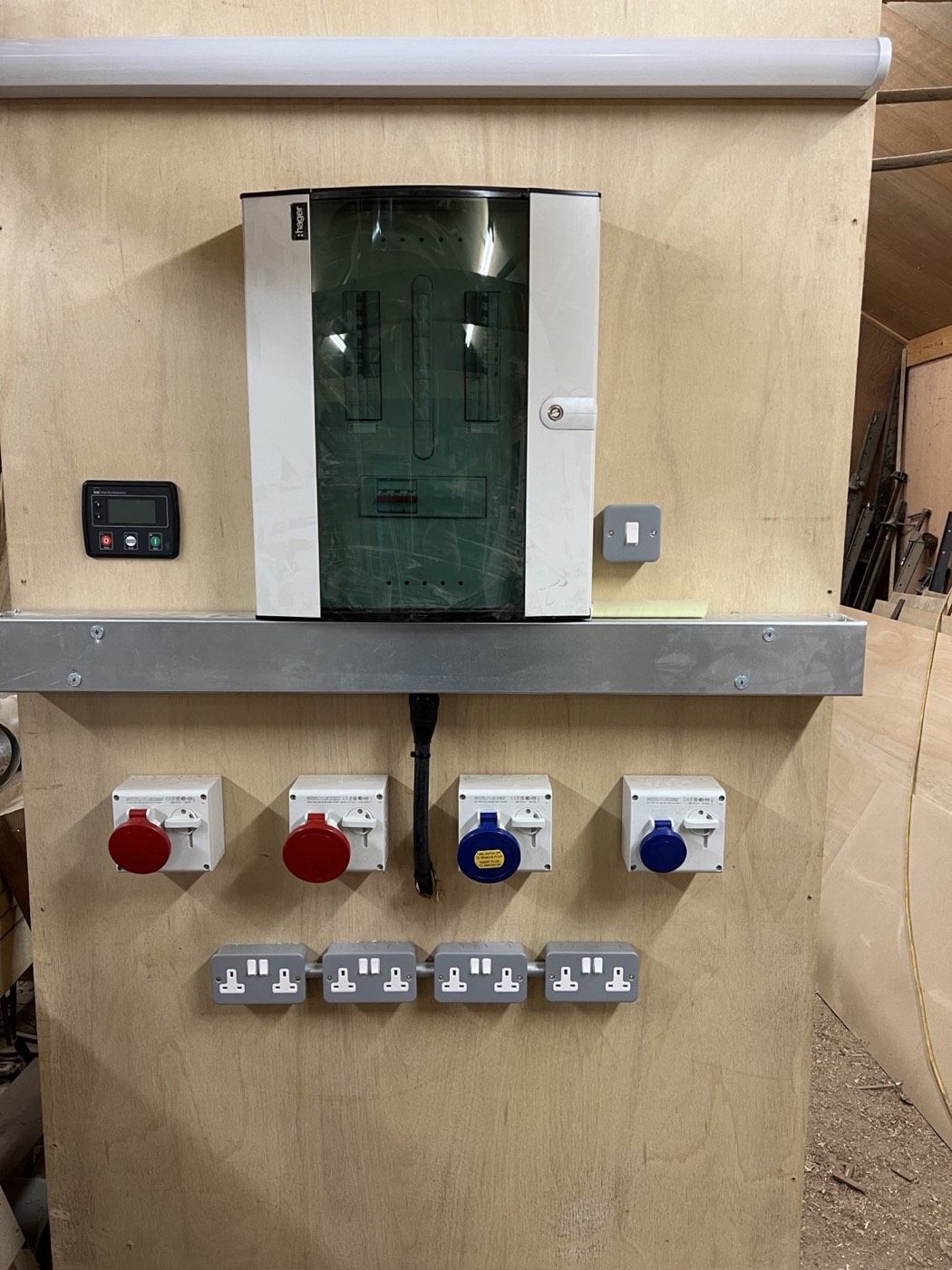
We built a new distribution board — a Hager consumer unit — with a bank of commando sockets and twin outlets, so power can be taken cleanly and safely to where the work happens across the yard.
- Hager consumer unit as the new distribution point for the site
- Bank of commando sockets for plant and heavier equipment
- Twin outlets for general and lighter loads
- Laid out so the yard's power can be extended or reconfigured without rebuilding it again
The Outcome
The lumber yard now has a fully serviced, modernised generator system as reliable sole-source power — not a machine that happens to be working, but one that has been brought up to standard and built around properly.
The remote start and monitoring give the customer visibility and control they simply didn't have before. On a site where that generator is genuinely all they've got, being able to see its condition and start it without a trip out is not a luxury feature — it's the thing that makes the site manageable.
Old doesn't mean finished. An industrial set like a Perkins is built to be serviced and run for decades. A generator that won't start is very often a fuel, starting or control fault rather than a dead engine — and the honest assessment is worth having before anyone quotes you for a replacement.
The service behind this project: Generator servicing, repairs & replacement — the same approach applied to your site. Call +44 7356 289964 or get in touch to talk it through.
Common questions.
Is it worth repairing an old generator, or should it be replaced?
Can an older generator have remote start and monitoring added?
What's different about a generator that's the only source of power?
Do you carry out generator servicing as well as installation?
Let's talk about your project.
No obligation — tell us about your site and we'll be straight with you about what makes sense.